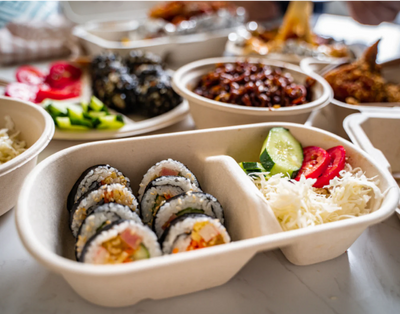

The holiday rush doesn't start when the orders arrive.
It starts weeks before.
Menus get updated. Promotions are planned. Staff schedules fill up. Ingredients are ordered. Delivery platforms prepare their campaigns.
Then Friday night arrives.
Orders start coming in faster than expected.
And someone realises you're running out of takeaway containers.
Or lids.
Or straws.
Or the new container doesn't actually fit the holiday menu.
Packaging isn't usually the most exciting part of peak-season planning, but when it goes wrong, it can become everyone's problem very quickly.
As restaurants, cafés and food delivery businesses prepare for the final months of 2026, September is a good time to look at something simple:
Is your takeaway packaging actually ready for Q4?
Here's what to check before the holiday rush begins.
1. Start With Last Year's Numbers
Before ordering more packaging, look backwards.
What happened during your previous peak season?
How much did order volume increase?
Which packaging items ran low?
Which menu items sold more than expected?
Were there days when you had to substitute one container for another?
Did delivery orders increase compared with dine-in?
Even basic historical information can help you avoid guessing.
For example, if your average monthly usage is 10,000 food containers but December demand historically increases by 30%, ordering based on a normal month may leave you scrambling halfway through peak season.
And don't only look at containers.
Review the entire packaging system:
-
Food containers
-
Lids
-
Cups
-
Straws
-
Cutlery
-
Napkins
-
Sauce containers
-
Takeaway bags
-
Delivery seals
-
Labels
Running out of one small component can create a surprisingly large operational headache.
Holiday checklist:
☐ Review Q4 2025 packaging consumption
☐ Compare dine-in vs takeaway growth
☐ Identify your highest-volume packaging SKUs
☐ Review previous shortages or emergency purchases
☐ Build additional buffer for promotional periods
2. Match the Packaging to Your Holiday Menu
Holiday menus change.
Packaging requirements often change with them.
Maybe you're introducing family-size portions.
A Christmas dessert box.
Seasonal drinks.
Party platters.
Corporate lunch sets.
Gift bundles.
Limited-edition menu items can create packaging problems when the product team and operations team plan separately.
Before launching a seasonal dish, physically test it in the proposed packaging.
Does it fit comfortably?
Can the lid close without touching the food?
Will sauce leak during delivery?
Can the container handle the temperature?
Will the food still look presentable when the customer opens it 30 minutes later?
This sounds obvious, but packaging decisions made from dimensions on a supplier specification sheet can feel very different once real food is involved.
Holiday checklist:
☐ Test every seasonal menu item in its intended packaging
☐ Check portion size and container capacity
☐ Test sauces, oils and liquids
☐ Confirm hot and cold food suitability
☐ Test presentation after delivery
3. Do the Delivery Test
Don't just put food in the container and leave it on a table.
Send it somewhere.
A takeaway container's real job begins when it leaves the restaurant.
Put together a typical order.
Pack it exactly as your staff would.
Stack the containers.
Add sauces.
Put everything into the delivery bag.
Then take it for a 20 to 30-minute journey.
If delivery times in your city are regularly longer, test that too.
When it arrives, open the order like a customer.
Is the food still where it should be?
Is the bottom of the container soggy?
Has anything leaked?
Did condensation affect the food?
Did one container crush another?
Is it easy to identify which meal belongs to which person?
A container that performs perfectly on the kitchen counter can behave very differently on the back of a motorbike.
Holiday checklist:
☐ Simulate a real delivery journey
☐ Test stacking
☐ Check for leaks
☐ Check condensation
☐ Evaluate the food after 20 to 30 minutes
☐ Test longer journeys if relevant
4. Don't Forget the Lid
Sometimes the container isn't the problem.
The lid is.
During busy periods, staff need packaging that closes quickly and reliably.
If employees have to press around a container three times to make sure it's sealed, that extra effort multiplies across hundreds of orders.
If lids pop open during delivery, the problem becomes much bigger.
When evaluating packaging, look at the system rather than the base alone.
Can staff close it easily?
Is it obvious when it's properly sealed?
Does it stay closed when stacked?
Can customers open it without fighting with the packaging?
Small usability details become much more important when your kitchen is processing peak-season volume.
5. Calculate Your Packaging Lead Time Now
December is not the ideal time to discover your packaging supplier needs several weeks to replenish an item.
Peak season affects more than restaurants.
Suppliers, logistics companies and manufacturers can also experience higher demand, holiday schedules and transportation constraints.
If you're planning higher volumes, customised packaging or a switch to a new material, start the conversation early.
Ask your supplier:
What is the current lead time?
Is the product stocked locally?
What is the minimum order quantity?
Does Q4 demand affect availability?
How much safety stock should we consider?
What happens if our demand exceeds forecast?
You don't necessarily need to fill a warehouse with packaging.
You do need to understand how quickly you can replenish it.
Holiday checklist:
☐ Confirm supplier lead times
☐ Review minimum order quantities
☐ Check local inventory availability
☐ Identify critical packaging items
☐ Establish a reasonable safety stock
☐ Confirm reorder dates before peak season
6. Avoid Emergency Packaging Purchases
When restaurants run out of packaging, sustainability strategies tend to disappear very quickly.
The priority becomes:
Find something that fits. Today.
That can mean buying whatever is locally available, regardless of material, quality, price or whether it matches the rest of the brand.
Emergency purchasing can also result in:
-
Higher unit costs
-
Inconsistent packaging
-
Poor-fitting lids
-
Unfamiliar materials
-
Excess inventory afterwards
-
More plastic than originally planned
Good forecasting isn't only a financial decision.
It helps businesses maintain their packaging standards during the busiest period of the year.
7. Review How Much Plastic Goes Into Each Order
Peak season is also a good opportunity to look inside a typical takeaway bag.
Not just at the main food container.
Everything.
How many pieces of single-use packaging are included?
A container.
A lid.
A sauce cup.
A spoon.
A fork.
A straw.
A plastic bag.
Another smaller bag.
Maybe cutlery wrapped inside another plastic sleeve.
Some items are necessary.
Others might be included automatically because that's how the restaurant has always done it.
Ask a simple question:
Does every customer actually need every item?
Making cutlery optional for delivery orders, for example, can help reduce unnecessary items while also lowering packaging consumption.
The most sustainable disposable item is sometimes the one you don't use.
Holiday checklist:
☐ Audit one complete takeaway order
☐ Identify unnecessary packaging
☐ Make cutlery optional where practical
☐ Reduce duplicate bags or wrapping
☐ Review single-use plastic alternatives
8. Consider Alternatives to Conventional Plastic
If your restaurant has been planning to reduce conventional single-use plastic, Q4 preparation can be a useful moment to review alternatives.
Depending on the application, options may include packaging made from materials such as paper, plant fibres or sugarcane fibre.
Sugarcane fibre, often called bagasse, is the fibrous material remaining after juice is extracted from sugarcane.
It can be moulded into food-service products such as:
-
Takeaway containers
-
Bowls
-
Plates
-
Trays
For restaurants, these products can provide an alternative to conventional plastic across suitable menu applications.
But don't switch based on appearance alone.
Test the alternative with your actual food.
A sustainable material still needs to survive the journey from kitchen to customer.
9. Look Beyond “Plant-Based”
The sustainable packaging market has grown quickly.
So has the vocabulary surrounding it.
Plant-based.
Biodegradable.
Compostable.
Natural.
Plastic alternative.
These terms can be useful, but they aren't interchangeable.
For example, some products made using renewable plant resources can contain PLA, or polylactic acid.
PLA is a bioplastic commonly produced using plant-derived sugars.
That means something can be plant-based while still containing a type of plastic.
If your restaurant specifically wants to avoid PLA, ask your supplier directly.
Is this product PLA-free?
The same applies to other material considerations.
For fibre-based food packaging, businesses may also want to ask about PFAS and whether relevant PFAS-free claims are supported by testing or verification.
A natural-looking container isn't automatically enough information to understand what's in it.
10. Check the Certifications, Not Just the Claims
Holiday packaging can become part of your marketing.
Restaurants may promote:
More sustainable takeaway packaging
Plant-based containers
Compostable packaging
Plastic alternatives
Before turning those claims into customer-facing communication, make sure you understand what your supplier can substantiate.
Ask for documentation.
Look at certifications.
Understand what each certification actually verifies.
If something is described as compostable, for example, find out under what conditions.
If something is described as PLA-free or PFAS-free, look for relevant supporting verification.
This protects more than your sustainability strategy.
It protects your credibility.
Customers are getting better at recognising vague green claims.
Specific information is much stronger than simply calling something "eco-friendly".
11. Make Disposal Instructions Easy to Understand
You've chosen a different packaging material.
Great.
Does the customer know what to do with it?
That's the next challenge.
If a container requires a particular disposal method, communicate that information as clearly as possible.
Don't assume customers understand the difference between:
Recyclable
Biodegradable
Industrially compostable
Home compostable
These terms describe different things.
A simple message on packaging, an order insert, your website or a QR code can help customers understand the intended end-of-life pathway.
Better materials work best when people know what to do with them.
12. Think About the Unboxing Moment
Restaurants spend enormous amounts of time perfecting how food looks on a plate.
Takeaway customers deserve some of that thinking too.
Open one of your delivery orders and look at it from the customer's perspective.
Does it feel organised?
Is there unnecessary packaging everywhere?
Are containers covered in sauce?
Can customers immediately tell what's inside?
Does the packaging feel consistent with the price and positioning of the restaurant?
For a customer ordering a premium meal, the container is effectively the plate.
And during the holiday season, customers may be ordering for groups, office celebrations, family gatherings and special occasions.
Presentation matters.
Packaging isn't simply carrying your product.
It is part of the product.
13. Train the Team Before the Rush
The best packaging system won't help if nobody knows how to use it properly.
If you're introducing new containers or changing your packing process before Q4, train employees before peak volume arrives.
Show them:
-
Which container goes with each menu item
-
How much food each container should hold
-
How lids should be closed
-
How containers should be stacked
-
Which sauces need separate packaging
-
When cutlery should be included
-
How delivery bags should be packed
If you have three containers that look almost identical but serve different purposes, make the distinction obvious.
During the holiday rush, people won't have time to study packaging specifications.
Good systems should make the correct choice easy.
Your Pre-Holiday Takeaway Packaging Checklist
Before Q4 gets busy, make sure you can answer yes to the following:
☐ We know our expected holiday order volume.
☐ We have reviewed last year's packaging consumption.
☐ Seasonal menu items have been tested in their intended containers.
☐ Packaging has been tested under real delivery conditions.
☐ We know supplier lead times and reorder dates.
☐ Critical packaging items have an appropriate buffer.
☐ We've reviewed unnecessary single-use items.
☐ Sustainable packaging alternatives have been tested for performance.
☐ We understand the materials in our packaging.
☐ Environmental claims are supported by appropriate documentation.
☐ Customers can understand how packaging should be disposed of.
☐ Staff know how to use the packaging correctly.
If several of those boxes remain unchecked in September, that's useful information.
You still have time to fix them before the holiday rush begins.
Where EQUO Fits In
EQUO provides food-service alternatives for restaurants, cafés, hospitality businesses and food delivery operators looking to reduce their reliance on conventional single-use plastic.
From sugarcane food containers to coffee, rice and sugarcane straws, EQUO products are designed to combine everyday functionality with more thoughtful material choices.
For applicable products, EQUO also places importance on material transparency and verification around claims such as PLA-free and PFAS-free.
Because when you're purchasing thousands of pieces of packaging, "looks sustainable" isn't enough.
You should know what you're buying.
Prepare Now. Thank Yourself in December.
The holiday rush will bring enough surprises.
Your takeaway containers shouldn't be one of them.
September is the time to test.
Forecast.
Order.
Ask questions.
Fix the packaging that leaked last year.
Find out what's actually inside the products you're using.
And make sure the packaging arriving at your customer's door represents your restaurant as well as the food inside it.
Because when Friday night gets busy, the best packaging is the packaging nobody in the kitchen has to think twice about.
It simply works.