
A few years ago, choosing more sustainable food packaging often meant one thing:
Replace plastic with something that looks greener.
In 2026, the conversation is much more sophisticated.
Restaurants, cafés, food delivery businesses and procurement teams are asking harder questions.
What is the packaging actually made from?
Does "plant-based" mean plastic-free?
Does it contain PLA?
What does compostable really mean?
Are there chemicals or coatings we should know about?
And perhaps most importantly:
Can the supplier prove the claims printed on the box?
As F&B businesses begin planning purchasing strategies for 2027, sustainable packaging is moving beyond appearance and broad environmental promises.
Here are seven trends we believe will shape the next phase of food and beverage packaging.
1. “Eco-Friendly” Is No Longer Enough
Look at almost any packaging catalogue today and you'll find the same vocabulary.
Green.
Natural.
Plant-based.
Eco-friendly.
Biodegradable.
These words aren't necessarily wrong. But customers and business buyers are becoming more interested in what sits behind them.
If a takeaway container is described as eco-friendly, what specifically makes it so?
If a straw is plant-based, what percentage of it comes from plant-derived materials?
Does it contain plastic?
If something is compostable, under what conditions?
This shift is important because sustainability is becoming less about the claim and more about the evidence supporting the claim.
For F&B businesses, that means packaging procurement may need to go deeper than comparing appearance, dimensions and unit price.
Material composition, testing, certifications and end-of-life information are increasingly part of the conversation.
What this means for 2027:
Ask suppliers to be specific.
A clear material specification tells you considerably more than a green leaf printed on a catalogue.
2. Material Transparency Is Becoming a Bigger Selling Point
For years, packaging was something most customers barely noticed unless it failed.
If the lid stayed closed, the drink didn't spill and the food arrived warm, the container had done its job.
That's changing.
Consumers are paying more attention to what everyday products are made from, particularly products that come into direct contact with food and drinks.
The growing conversation around plastics, microplastics, PFAS and bioplastics has made material composition more visible.
This creates both a challenge and an opportunity for F&B brands.
The challenge is that vague claims are easier to question.
The opportunity is that businesses making thoughtful material choices have more to communicate.
Instead of saying:
“We use sustainable packaging.”
A restaurant may be able to explain:
“Our takeaway containers are made from sugarcane fibre.”
Or:
“We've switched to straws verified as PLA-free and PFAS-free.”
Specificity builds a stronger story.
What this means for 2027:
Know what's in your packaging before your customers ask.
Material transparency shouldn't live only in your supplier's technical documents. It can become part of your customer experience.
3. Plant-Based Packaging Is Getting a Closer Look
Plant-based packaging has become one of the most recognisable areas of sustainable packaging.
And for good reason.
Agricultural materials and renewable feedstocks can provide alternatives to conventional fossil-based materials across a variety of applications.
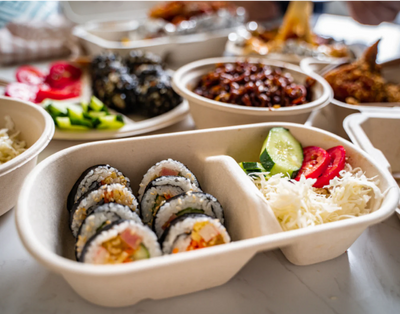
Sugarcane fibre, for example, can be moulded into food containers, plates, bowls and trays.
Agricultural materials can also be incorporated into products such as straws and stationery.
But 2026 has also brought more awareness of an important distinction:
Plant-based doesn't automatically mean plastic-free.
PLA, or polylactic acid, is one example.
PLA is a bioplastic commonly produced using sugars derived from renewable resources such as corn or sugarcane.
So a product containing PLA can legitimately be described as having plant-derived content.
But PLA is still a polymer classified as plastic.
That doesn't make every PLA product inherently bad or misleading.
It simply means buyers should understand what they're purchasing rather than relying on the phrase "plant-based" alone.
What this means for 2027:
Ask for the full material composition.
If avoiding PLA is part of your company's packaging strategy, look specifically for PLA-free products and supporting verification rather than assuming all plant-based packaging meets that requirement.
4. PFAS-Free Packaging Is Moving Further Into the Conversation
Food packaging has a difficult job.
It needs to deal with oil, moisture, sauces, heat and transportation without falling apart before the customer gets their meal.
Historically, PFAS have been used across various applications because of properties including resistance to grease and water.
But growing attention around these synthetic chemicals has changed the packaging conversation.
For procurement teams, "What is this container made from?" may no longer be enough.
Another question is increasingly relevant:
“What else has been added to make it perform?”
This is particularly important when comparing fibre-based packaging products that may look almost identical.
Appearance doesn't necessarily tell you how a product was manufactured or treated.
What this means for 2027:
When evaluating food packaging, ask suppliers about PFAS and whether relevant PFAS-free claims have been independently tested or verified.
Choosing fibre-based packaging shouldn't mean stopping your questions at the word "fibre".
5. Compostability Is Becoming More Specific
For a long time, COMPOSTABLE could function almost like a finish line.
See the word. Feel good about the choice. Move on.
But businesses and consumers are becoming more aware that compostability isn't quite that simple.
Different products may require different environments to break down as intended.
Industrial composting facilities can operate under controlled conditions involving temperature, moisture and aeration.
Home composting occurs under different conditions.
Then there is another practical question:
Does the required composting infrastructure actually exist where the product is being used?
A product's theoretical end-of-life pathway and its real-world end-of-life pathway are not always the same.
That doesn't make compostability irrelevant.
It makes disposal education more important.
What this means for 2027:
Don't stop at "compostable".
Ask:
Is it home or industrially compostable?
What certification supports the claim?
What disposal conditions are required?
Can customers access the appropriate waste stream?
The next generation of sustainable packaging communication needs to explain not only what a product is made from, but what customers should do with it afterwards.
6. Packaging Performance Still Comes First
Sustainability matters.
But if the curry arrives at the customer's door inside the delivery bag instead of inside the container, nobody is going to be impressed by the packaging's environmental credentials.
This is an important reality for the F&B industry.
Packaging still needs to perform.
It needs to:
-
Hold the food securely
-
Handle the intended temperature
-
Resist leaks and grease where required
-
Survive transportation
-
Stack efficiently
-
Work with restaurant operations
-
Present the food properly
-
Provide a good customer experience
The strongest sustainable packaging solutions aren't simply alternatives to conventional packaging.
They're alternatives that work.
For restaurants, switching materials without testing the packaging in real operating conditions can create unnecessary problems.
A container might work perfectly for sandwiches but poorly for a sauce-heavy meal.
A straw suitable for juice may perform differently in another type of beverage.
A delivery format that works for a 10-minute journey might need additional consideration for orders travelling across a city.
What this means for 2027:
Test packaging with your actual menu.
Put your food in it.
Close it.
Stack it.
Transport it.
Leave it for the same amount of time as a real delivery.
Then open it as your customer would.
Sustainability and functionality should not be competing requirements.
7. Packaging Is Becoming Part of the Brand Experience
Takeaway packaging used to be almost invisible.
Today, it can be one of the most visible physical touchpoints between a food brand and its customers.
Think about a delivery-only restaurant.
The customer may never see the kitchen.
They may never meet an employee.
They may interact with the brand entirely through an app until one physical object arrives at their door:
the packaging.
That container is now part of the brand experience.
Does it feel cheap?
Does it leak?
Is it covered in unnecessary plastic?
Is it easy to open?
Does the material align with what the brand says it believes?
This is particularly relevant for brands positioning themselves around wellness, sustainability, premium ingredients or responsible sourcing.
If everything about your brand says "thoughtful" but the order arrives surrounded by unnecessary disposable plastic, customers may notice the disconnect.
What this means for 2027:
Treat packaging as part of your brand strategy, not just an operating expense.
The material, design and disposal experience all communicate something about your business.
The Cheapest Container Isn't Always the Cheapest Choice
Cost will always matter in food service.
When a business uses thousands or millions of pieces of packaging, even a small difference in unit price can become significant.
But unit price doesn't tell the whole story.
Poor packaging can create other costs:
Leaks and spills
Damaged meals
Customer complaints
Refunds
Poor delivery reviews
Excessive secondary packaging
Brand inconsistency
Wasted food
On the other hand, the most expensive packaging isn't automatically the best choice either.
The goal is to find the right balance between performance, material choice, customer experience and cost.
For procurement teams planning 2027 packaging strategies, the question shouldn't only be:
“How much does one container cost?”
It should also be:
“What value, risk and experience come with that container?”
Certifications Will Matter More Than Sustainability Buzzwords
As environmental claims become more common, credible differentiation becomes harder.
Anyone can design green packaging.
Anyone can print a leaf.
Anyone can describe a product using words that sound sustainable.
Verification creates a different level of confidence.
Certifications and independent testing can help businesses understand specific characteristics of a product, from compostability to material composition and the absence of particular substances.
The important point is to understand what each certification actually verifies.
A certification for one attribute doesn't automatically mean a product is environmentally preferable in every possible way.
But it does give buyers something concrete to evaluate.
This is why EQUO places importance on verification for relevant product claims, including PLA-free and PFAS-free verification for applicable products.
Not because a logo should replace the conversation.
Because it should support it.
What Should F&B Businesses Do Before 2027?
You don't need to replace every piece of packaging overnight.
Start with an audit.
Look at the disposable products your business uses most frequently.
Takeaway containers.
Cups.
Lids.
Straws.
Cutlery.
Plates and bowls.
Delivery packaging.
Then ask a few questions.
What is each item made from?
Don't rely only on the product name.
Does it contain conventional plastic or bioplastic?
Understand the complete composition.
Are environmental claims independently verified?
Ask suppliers for supporting documentation where relevant.
Does the product work with your menu?
Test it under real operating conditions.
What happens after customers use it?
Consider realistic disposal options in your market.
Can you eliminate anything altogether?
Sometimes the most sustainable packaging decision is simply not providing an item unless the customer needs it.
That might mean making cutlery optional for delivery orders or removing unnecessary layers of packaging.
Small operational changes multiplied across thousands of orders can become meaningful.
The Sustainable Packaging Conversation Is Growing Up
Perhaps the biggest sustainable packaging trend of 2026 isn't a particular material.
It's better questions.
Consumers are becoming more sceptical of vague environmental language.
Businesses are looking more closely at material composition.
Procurement teams are asking for certifications.
Restaurants are considering how packaging affects the customer experience.
And the conversation is shifting from:
“Does this look sustainable?”
to:
“Can we understand and verify why it is a better choice?”
That's progress.
Because there probably won't be one perfect material that solves every packaging challenge.
Different foods, businesses and waste systems need different solutions.
What we can demand is greater transparency about those solutions.
Planning Your Packaging Strategy for 2027?
At EQUO, we believe sustainable packaging should be practical enough for everyday business and transparent enough for customers to understand.
From sugarcane food containers to coffee, rice and sugarcane straws, our products give F&B businesses alternatives to conventional single-use plastics while putting greater emphasis on material transparency and verified claims.
As you plan for 2027, don't simply ask your packaging supplier what's new.
Ask what's inside.
Ask how it performs.
Ask what happens after use.
And ask for the evidence behind the environmental claims.
Because the future of sustainable packaging isn't about looking greener.
It's about knowing what you're choosing, and why.