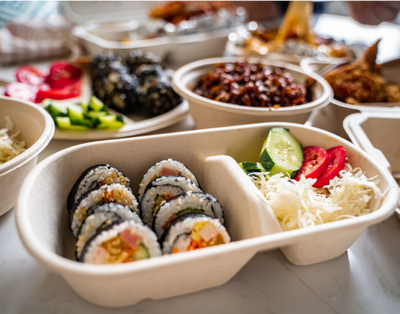

A customer orders takeaway from your restaurant.
The food is freshly prepared. The presentation is perfect. Everything looks delicious.
Then comes the final step.
Packaging.
Do you put the meal in a plastic container? A paper box? Or one of those natural-looking sugarcane containers you've been seeing everywhere?
At first glance, it might seem like a simple purchasing decision.
After all, it's just a box, right?
Not quite.
The food container you choose can affect everything from food presentation and delivery performance to purchasing costs, customer experience and your restaurant's environmental footprint.
And with more food businesses exploring alternatives to conventional single-use plastic, the options can feel overwhelming.
So, sugarcane vs paper vs plastic food containers: which one is actually better?

The answer depends on what you're serving, how you're serving it and what matters most to your business.
Let's break it down.
Why Your Choice of Takeaway Packaging Matters
Takeaway packaging does more than hold food.
It protects meals during transportation, helps prevent leaks and spills, and influences how customers experience your brand.
Think about the last time you ordered food delivery.
Did the container arrive intact?
Was the food still appetising?
Did the sauce leak into the delivery bag?
Was the packaging easy to open?
These details might seem small, but they contribute to the overall experience.
For restaurants, poor packaging can lead to customer complaints, refunds, wasted food and additional operational costs.
At the same time, excessive or unnecessary packaging creates its own problems.
The challenge is finding a balance between functionality, cost and environmental considerations.
Three common options worth comparing are sugarcane fibre, paper and plastic.
1. Sugarcane Food Containers: Turning Agricultural Residue Into Packaging
Sugarcane food containers are typically made using bagasse, the fibrous material remaining after sugarcane stalks are crushed to extract their juice.
Instead of treating this residue solely as waste, manufacturers can process it into moulded fibre products.
These include:
-
Takeaway clamshell containers
-
Food trays
-
Plates
-
Bowls
-
Compartment food containers
The result is a food-service packaging option made using plant-derived fibre.
What Makes Sugarcane Containers Interesting?

One of the main attractions of sugarcane packaging is its use of an agricultural by-product.
Bagasse is already generated during sugar production, so using it in food-service products creates another potential application for that material.
Sugarcane containers also have a distinctive natural appearance.
Their neutral colour and moulded texture can work well for restaurants, cafés and food brands looking for a more understated packaging aesthetic.
Depending on their design and specifications, sugarcane containers can be suitable for various hot and cold foods.
However, not all sugarcane containers perform identically.
Grease resistance, moisture resistance, structural strength and temperature tolerance depend on the product's manufacturing process and any additives or coatings used.
That's why it's important to test the actual container with your menu.
What Should Restaurants Consider?
Sugarcane containers may be worth exploring if your restaurant wants to reduce its reliance on conventional single-use plastic packaging.
But remember to check:
-
Whether the container is suitable for hot food
-
How it performs with oily or saucy dishes
-
Whether the lid closes securely
-
How it holds up during delivery
-
Whether the product contains additional coatings or additives
-
What disposal options are available locally
And don't assume every sugarcane product is automatically plastic-free or compostable.
Those characteristics should be confirmed for the specific product.
2. Paper Food Containers: Familiar, Versatile and Widely Available
Paper food packaging is everywhere.
From takeaway noodle boxes to sandwich wraps, soup cups and bakery bags, paper-based products are a familiar part of the food-service industry.
Their popularity comes from their versatility.
Paper can be folded, printed, shaped and combined with different materials to create a wide range of packaging formats.
What Makes Paper Containers Useful?

Paper packaging can be particularly attractive for businesses that want custom branding.
It generally offers a suitable surface for printing logos, colours and promotional messages, depending on the finish and construction.
Paper-based packaging is also available in many shapes and sizes.
For dry foods, baked goods and certain takeaway applications, it can be a practical option.
However, paper has an important limitation.
Paper alone doesn't necessarily provide the moisture and grease resistance required for every food application.
To improve performance, some paper containers use coatings or linings.
These may include plastic-based materials such as polyethylene or PLA.
That means a paper container isn't always made entirely from paper.
What Should Restaurants Consider?
If you're considering paper packaging, ask your supplier about the complete material composition.
Does the container have a lining?
What is the lining made from?
Can the product be recycled through local collection systems?
Is it suitable for hot, oily or liquid-heavy food?
A paper container that looks recyclable may not be accepted by every recycling facility, particularly when it contains certain coatings or is heavily contaminated with food.
The material's appearance doesn't tell the whole story.
3. Plastic Food Containers: Practical, but With Environmental Trade-Offs
Plastic food containers remain common across the takeaway and food delivery industry.
Materials such as polypropylene (PP) and polyethylene terephthalate (PET) are used in different packaging applications.
Plastic containers can offer useful properties, including moisture resistance, relatively low weight and a wide range of shapes and designs.
Some are transparent, allowing customers to see the food inside.
Others are designed for specific temperature requirements.
Why Do Restaurants Still Use Plastic?
For many businesses, plastic packaging is familiar and readily available.
It can be competitively priced, especially at high purchasing volumes.
Depending on the polymer and container design, plastic packaging may provide good resistance to moisture and certain food substances.
However, different plastics have different properties.
A container suitable for cold salad may not be suitable for hot soup.
A product that is microwave-safe under specified conditions should not be confused with one that has no verified microwave suitability.
Restaurants should always check the manufacturer's specifications.
What Are the Environmental Concerns?
Conventional plastic packaging is commonly produced using fossil-derived materials.
When poorly managed after use, plastic waste can persist in the environment and contribute to pollution.
Some plastic food containers may be technically recyclable, but actual recycling depends on the material, food contamination, local collection infrastructure and processing capabilities.
Not every plastic container placed in a recycling bin will be recycled.
For restaurants aiming to reduce conventional single-use plastic consumption, alternative materials may be worth evaluating.
Sugarcane vs Paper vs Plastic: A Side-by-Side Comparison
Here's a simplified comparison to help restaurants understand the key differences.
| Feature | Sugarcane Fibre | Paper | Conventional Plastic |
|---|---|---|---|
| Main material | Sugarcane bagasse | Wood-derived paper fibre | Plastic polymers, often fossil-derived |
| Typical appearance | Natural, moulded fibre | Smooth, printable surface | Clear, coloured or opaque |
| Hot food suitability | Depends on product specifications | Depends on coatings and construction | Depends on plastic type |
| Grease resistance | Varies by formulation | Often requires treatment or lining | Varies by polymer and design |
| Moisture resistance | Varies by formulation | Often requires coating | Generally good for suitable designs |
| Custom branding | Depends on product and printing options | Often highly customisable | Depends on product and process |
| Recycling | Depends on composition and local facilities | Depends on coatings, contamination and local facilities | Depends on polymer and local facilities |
| Compostability | Possible for appropriately certified products | Possible for appropriately certified products | Generally not for conventional plastics |
| Cost | Depends on specifications and order volume | Depends on construction and coatings | Often competitively priced |
Important: This comparison describes general material characteristics. Performance, certifications and disposal requirements vary by individual product.
Which Container Is Best for Different Types of Food?
The most useful way to choose packaging isn't to ask which material is universally best.
It's to start with the food.
For Rice Meals and Lunch Boxes
Rice dishes, grilled meats, vegetables and mixed meals often require containers that maintain their shape and accommodate different food components.
Compartment containers can help separate sauces and side dishes.
Sugarcane fibre containers may be suitable for these applications when their specifications match the food.
Paper and plastic options may also work, depending on their construction.
For Salads and Cold Meals
Cold meals often benefit from packaging that maintains presentation and prevents dressing from leaking.
Some restaurants prefer transparent containers so customers can see the ingredients.
Others prioritise reducing conventional plastic use.
Whichever material you choose, consider moisture resistance, lid security and the way the food is presented.
For Soups and Liquid-Heavy Dishes
Soups are one of the more demanding takeaway applications.
A suitable container needs to resist leakage and perform at the intended serving temperature.
Not every sugarcane or paper container is designed for liquid-heavy food.
And not every plastic container is suitable for hot liquids.
Always test the complete container-and-lid system under realistic conditions.
For Fried and Oily Foods
Fried chicken, chips and other oily foods create their own challenges.
Grease resistance is important, but ventilation can also affect food texture.
Packaging that traps too much steam may cause crispy food to become soggy.
Consider both material performance and container design.
A suitable container should help preserve the intended eating experience.
What About Compostable Food Containers?
Compostability is often a major consideration when restaurants compare alternative packaging materials.
However, the term should be understood carefully.
A product described as compostable is intended to break down under defined composting conditions.
Those conditions may involve industrial composting facilities or specific home composting environments.
Compostable does not mean the product will quickly disappear if littered or placed in a landfill.
It also doesn't guarantee that local waste management systems will accept it.
For example, a certified industrially compostable container may require a facility capable of processing it under the relevant conditions.
If that facility isn't available, the intended disposal pathway may not be practical.
Before purchasing compostable packaging, restaurants should confirm the product's certification and check local disposal options.
The same applies to claims such as biodegradable, recyclable and plastic-free.
Clear documentation matters.
Does Plant-Based Packaging Always Mean Plastic-Free?
Not necessarily.
This is one of the most common misunderstandings surrounding sustainable food packaging.
Some products made using plant-derived materials contain PLA, or polylactic acid.
PLA is a type of bioplastic commonly produced from renewable plant-derived feedstocks.
It may be used as a coating, lining or component in certain packaging products.
So a container can be described as plant-based while still containing plastic.
Similarly, some fibre-based food containers may use additional substances to improve resistance to grease or moisture.
For businesses specifically seeking PLA-free or PFAS-free products, it's important to request relevant information and verification from suppliers.
Don't rely entirely on the colour, texture or marketing description of a container.
Natural-looking packaging isn't the same as verified material composition.
Is Sustainable Food Packaging More Expensive?
This is one of the first questions restaurant owners ask.
And understandably so.
Packaging is a recurring operational expense.
A small difference in unit price can become significant when multiplied across thousands of takeaway orders.
However, comparing packaging costs requires more than looking at the price per container.
Consider the total cost of using the product.
For example:
Container price: What is the unit cost at your expected purchasing volume?
Packaging efficiency: Does the container fit your menu, or are you paying for unnecessary size and material?
Delivery performance: Does the packaging help prevent spills, damage and customer complaints?
Storage requirements: How much space does the packaging occupy?
Operational efficiency: Is it easy for staff to fill, close and stack?
Customer experience: Does the packaging present the meal appropriately?
Disposal requirements: Are there additional collection or waste management considerations?
A cheaper container that frequently fails during delivery may create costs elsewhere.
Likewise, an expensive container with unnecessary features may not be the right investment.
The goal is to find a packaging solution that delivers appropriate performance and value.
6 Questions to Ask Before Switching Food Packaging Suppliers
If your restaurant is considering a switch from conventional plastic to sugarcane or paper packaging, use this checklist before placing a bulk order.
1. What exactly is the product made from?
Request the full material composition, including any coatings or linings.
2. Is it suitable for our menu?
Test the container with your actual dishes, especially hot, oily or liquid-heavy foods.
3. What environmental claims can be verified?
Ask for applicable certifications and test reports.
4. What are the minimum order quantities and lead times?
Make sure the supplier can support your expected demand.
5. How does the packaging perform during delivery?
Check lid security, stacking performance and resistance to leaks.
6. What happens to the packaging after use?
Understand which disposal options are realistically available in your market.
A supplier should be able to help you understand the product, not simply provide a price list.
Why Restaurants Are Exploring Sugarcane Food Packaging
For restaurants looking to move away from conventional single-use plastic, sugarcane fibre offers an interesting material alternative.
It makes use of a by-product from sugar production and can be moulded into a variety of food-service formats.
Its natural appearance can also complement businesses that want their packaging choices to reflect a more resource-conscious approach.
But the decision should still be based on performance.
Not every sugarcane container is suitable for every food application.
And not every environmental claim applies to every product.
The best approach is to work with a supplier that can explain the material, provide relevant specifications and help identify suitable options.
Explore Sugarcane Food Containers With EQUO

At EQUO, we believe everyday food-service products deserve more thoughtful material choices.
Our range includes sugarcane food containers and tableware, alongside alternative straws made using materials such as coffee grounds, rice and sugarcane.
For restaurants, cafés, catering businesses and food delivery operators, our products offer alternatives to conventional single-use plastic across different food-service applications.
We also believe material transparency is essential.
Where applicable, PLA-free and PFAS-free claims should be supported by relevant product verification rather than broad assumptions about plant-derived materials.
Whether you're sourcing takeaway containers for a new restaurant or reviewing packaging across multiple locations, understanding your options is the first step.
Contact EQUO to explore our sugarcane food packaging range, discuss your requirements and request a quotation for bulk orders.
The Best Food Container Is the One That Fits Your Business
So, sugarcane, paper or plastic?
There isn't one universal winner.
Paper may work well for certain dry foods and branded applications.
Plastic may offer useful performance characteristics in specific applications, although conventional plastic creates environmental concerns.
Sugarcane fibre provides an alternative material option for businesses exploring ways to reduce their reliance on conventional single-use plastic.
What matters is choosing packaging that suits your food, protects the customer experience and aligns with your purchasing priorities.
Don't choose a container simply because it looks sustainable.
Don't choose one solely because it's cheap.
And don't assume one material will work for every item on your menu.
Choose packaging based on what it's made from, how it performs and what happens after it's used.
Because the right food container should do more than hold a meal.
It should help your business deliver it well.