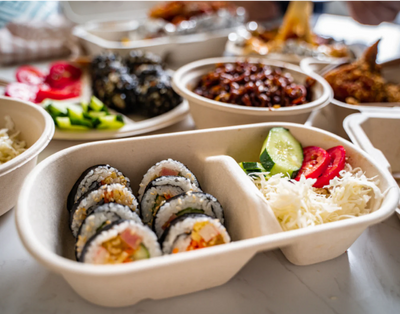

$0.12 per container.
Or $0.15.
If you're buying 100,000 units, the cheaper option seems obvious.
That's $3,000 saved.
Decision made.
Except six weeks later, the cheaper container starts creating problems.
Sauce leaks into delivery bags.
Staff begin double-packing certain dishes.
Customers complain that food arrives crushed.
Extra napkins are added "just in case".
Refunds start appearing.
Then someone suggests putting each container into an additional plastic bag to stop the mess.
Suddenly, that three-cent saving isn't quite as simple as it looked on the quotation.
For restaurants and F&B businesses operating at scale, packaging cost matters.
But unit price is only one part of what packaging actually costs your business.
The cheapest container on the spreadsheet can sometimes become one of the more expensive choices in practice.
Here's what restaurants should consider before making packaging decisions based on price alone.
1. Start With the Cost Per Order, Not Cost Per Container
Procurement often compares products individually.
Container A: $0.12.
Container B: $0.15.
Container A wins.
But customers don't receive packaging as individual SKUs.
They receive an order.
If the cheaper container requires additional items to perform properly, the real calculation changes.
Imagine Container A needs:
Container: $0.12
Extra liner: $0.02
Plastic bag for leak protection: $0.03
Suddenly, the packaging system costs $0.17.
Container B might cost $0.15 but perform without the additional materials.
The "more expensive" product is now two cents cheaper per order.
Multiply that by 100,000 orders and the economics look very different.
Before comparing quotations, calculate:
Total packaging cost per completed customer order.
Not simply the price of one component.
2. A Leak Costs More Than the Container
One leaking takeaway meal can create an impressive chain reaction.
Sauce escapes from the container.
It covers the bag.
The napkins are ruined.
Maybe it reaches another meal in the same order.
The customer takes a photo.
They contact the restaurant or delivery platform.
Customer service gets involved.
The restaurant issues a refund or replacement.
Perhaps the customer leaves a negative review.
How much did the leak cost?
Definitely more than three cents.
Packaging is essentially insurance for everything your kitchen has already invested in the meal.
Ingredients.
Labour.
Energy.
Preparation time.
Delivery.
Brand reputation.
The container's job is to protect all of that until the customer is ready to eat.
Saving money on packaging only makes sense if the packaging still does its job.
3. Double Packaging Is a Warning Sign
Watch what your staff do during a busy shift.
They'll often tell you more about packaging performance than a supplier specification sheet.
If employees routinely:
Add a second container.
Wrap something in plastic.
Use extra bags.
Add excessive napkins around a container.
Tape lids closed.
Avoid filling containers past a certain point because they don't trust the lid.
Your packaging system may already be telling you something.
These workarounds have costs.
Extra material.
Extra labour.
Extra waste.
Extra complexity.
And potentially slower order preparation.
If your team has invented a second packaging system to make the first one work, the first system may not be as inexpensive as it appears.
4. Labour Has a Packaging Cost Too
Consider two containers.
Container A takes approximately five seconds to close securely.
Container B is awkward and takes 12 seconds.
Seven seconds sounds insignificant.
Until your team closes 1,000 containers.
That's 7,000 additional seconds.
Nearly two hours of extra handling time.
Now repeat that across days, weeks and multiple locations.
This doesn't mean you should start timing employees with a stopwatch every time they close a lunch box.
It means ease of use matters operationally.
During peak periods, good packaging should help the kitchen move.
Staff should know immediately:
Which container to use.
How much food goes inside.
How the lid closes.
How containers stack.
How the order should be packed.
Packaging that creates friction can quietly increase labour requirements without ever appearing as a line item on the packaging quotation.
5. Food Waste Is More Expensive Than Packaging Waste
Restaurants spend significant time optimising food cost.
Portion control.
Ingredient sourcing.
Yield.
Prep waste.
Inventory.
Then the finished meal gets placed into packaging that isn't suitable for the food.
If the container fails and the meal needs to be replaced, you're not only losing packaging.
You're losing the food inside it.
This is why packaging should be tested with real menu items rather than selected entirely from a catalogue.
A container that works beautifully for a sandwich may not be appropriate for curry.
A bowl that works for salad may perform differently with hot soup.
Greasy food creates different requirements from dry baked goods.
Packaging cost needs to be evaluated alongside the value of what it's protecting.
A $15 meal shouldn't be compromised to save a few cents on the container carrying it.
6. Customer Experience Has a Cost Too
Takeaway and delivery have changed the role of packaging.
For dine-in customers, the experience includes:
The restaurant.
The lighting.
The plate.
The service.
The presentation.
For delivery customers, many of those touchpoints disappear.
The packaging becomes one of the few physical interactions they have with your brand.
Imagine ordering from a premium restaurant.
You spend $40.
The food arrives inside flimsy containers, one lid has opened slightly and sauce has leaked into the bag.
The food might still taste excellent.
But does the experience feel like $40?
Now imagine the same meal arriving neatly packed, intact and well presented.
Same kitchen.
Same ingredients.
Same chef.
Different perception.
Packaging doesn't just transport food.
It frames the experience of receiving it.
7. Cheap Packaging Can Become Expensive Marketing
Customers photograph takeaway food.
They film unboxings.
They post delivery orders.
They review restaurants.
That means packaging can appear in your marketing whether you planned for it or not.
If the packaging looks considered, it can reinforce your brand.
If it arrives crushed or covered in sauce, that can become part of your brand too.
This is especially relevant for restaurants investing heavily in visual identity.
You can spend thousands developing:
A logo.
Menu design.
Photography.
Social media.
Interior design.
Then send the customer's food home in packaging that feels completely disconnected from the brand.
The packaging budget and marketing budget may sit in different spreadsheets.
The customer experiences them together.
8. Sustainability Can Affect Perceived Value
Packaging materials can also influence how customers perceive a restaurant's values.
Consumers increasingly encounter businesses talking about:
Sustainability.
Responsible sourcing.
Reducing plastic.
Waste reduction.
Better materials.
If a brand communicates those values publicly but every takeaway order arrives with layers of unnecessary single-use plastic, customers may notice the contradiction.
This doesn't mean every restaurant needs to replace all packaging immediately.
It means packaging choices should be considered alongside the brand's broader positioning.
For businesses looking to reduce reliance on conventional single-use plastic, materials such as sugarcane fibre can provide alternatives for suitable food-service applications.
Sugarcane fibre, also known as bagasse, can be moulded into products including:
-
Food containers
-
Plates
-
Bowls
-
Trays
But material alone isn't enough.
It still needs to perform.
9. “Sustainable” Packaging Can Be Cheap in the Wrong Ways Too
A higher price or natural-looking material doesn't automatically mean better packaging.
The same scrutiny should apply to products marketed as sustainable.
Does it hold your food properly?
Does it resist the grease level of your menu?
Can it handle the required temperature?
Does the lid stay closed?
Does it stack efficiently?
What is it actually made from?
What do its environmental claims mean?
Are those claims supported by appropriate testing or certification?
A brown fibre container isn't automatically the right choice simply because it looks more natural than plastic.
Procurement decisions should combine:
Performance + material + cost + operational fit + end-of-life considerations.
Not appearance alone.
10. Know What's Actually in the Product
Price comparisons become particularly interesting when two products look almost identical.
Take two plant-based straws.
Or two fibre food containers.
At first glance, they may appear interchangeable.
But material composition can differ.
For example, some products described as plant-based can contain PLA, or polylactic acid, a bioplastic commonly produced using renewable plant feedstocks.
If your business specifically wants a PLA-free product, the words "plant-based" alone don't provide enough information.
Similarly, businesses purchasing fibre-based food packaging may want information about PFAS and whether relevant PFAS-free claims are supported by verification.
Ask suppliers for specifications.
Ask for supporting documents.
Ask what certifications actually cover.
A cheaper quotation isn't necessarily comparable if you're not comparing the same material characteristics.
11. Storage Space Is Part of the Cost
Packaging doesn't magically appear next to the kitchen when you need it.
It needs to be stored.
For restaurants operating in expensive urban locations, storage space can be limited.
Packaging that is bulky, inefficiently nested or supplied in awkward carton quantities can consume valuable space.
This becomes particularly important for businesses with:
-
Small back-of-house areas
-
Multiple packaging SKUs
-
Seasonal menus
-
High delivery volumes
-
Central warehouses
-
Multiple restaurant locations
Consider carton dimensions, units per carton and stacking efficiency when evaluating products.
The lowest unit price might require significantly more storage capacity.
That capacity isn't free.
12. Inventory Waste Is Still Waste
Bulk purchasing often reduces unit cost.
So the temptation is obvious:
Buy more.
But what happens if the menu changes?
The restaurant rebrands.
A container size changes.
Customer demand falls.
A location closes.
Or the product simply doesn't perform as expected?
You may end up with thousands of unused containers sitting in storage.
The discount you earned by ordering a larger quantity can quickly disappear if a portion of the inventory is never used.
Forecasting matters.
So does testing before committing to large volumes.
A slightly higher unit price with more flexible order quantities can sometimes create a better overall commercial outcome.
13. The Cheapest Supplier Can Create Expensive Emergencies
Price isn't the only thing you're buying from a packaging supplier.
You're also buying:
Availability.
Consistency.
Lead time.
Quality.
Documentation.
Communication.
Reliability.
If a low-cost supplier can't replenish stock when you need it, your restaurant may be forced into an emergency purchase.
And emergency packaging purchases are rarely cheap.
You might pay a premium for locally available stock.
Accept a product that doesn't match your existing packaging.
Return temporarily to conventional plastic.
Or purchase quantities that don't fit your forecast.
Supplier reliability therefore belongs in the total cost conversation too.
Build a Better Packaging Cost Calculation
Instead of comparing only:
Unit Price
consider a broader equation:
Packaging Purchase Cost
Additional Packaging Required
Handling and Labour
Storage
Food Loss or Replacement Risk
Customer Complaints and Refunds
Inventory Waste
Emergency Purchasing Risk
=
Real Packaging Cost
Not every category needs an exact dollar value.
The point is to make the hidden trade-offs visible.
A one-cent saving becomes much less impressive if it creates five cents of additional operational cost.
A Simple Test Before You Choose
Before approving a new takeaway package, run it through five tests.
1. The Food Test
Put your actual menu item inside it.
Not a sample weight.
Real food.
2. The Time Test
Leave the meal inside for the typical delivery time.
3. The Transport Test
Take it on an actual delivery journey.
4. The Staff Test
Ask kitchen employees to pack multiple orders with it during a realistic workflow.
5. The Customer Test
Open the final order as if you'd just paid for it.
Then ask:
Would I be happy receiving this?
If the answer is no, a lower unit price probably won't fix the problem.
Where EQUO Fits In
EQUO develops alternatives for F&B businesses looking to reduce their reliance on conventional single-use plastic without forgetting that packaging still needs to work in the real world.
Our food-service range includes products such as sugarcane food containers and coffee, rice and sugarcane straws designed for everyday hospitality and takeaway applications.
Material transparency is also an important part of the conversation.
For applicable EQUO products, relevant claims including PLA-free and PFAS-free are supported by verification, helping businesses understand more about the products they're purchasing rather than relying only on broad terms such as "green" or "plant-based".
Because the right packaging decision isn't always the cheapest option on the quotation.
It's the option that makes sense once the whole order reaches the customer.
Don't Ask Only “How Much Does It Cost?”
Ask:
Does it work?
Will my staff need extra packaging to make it work?
Will it protect the food?
Will it survive delivery?
Does it fit our brand?
Do we understand what it's made from?
Can our supplier support us at scale?
And then ask how much it costs.
Price still matters.
It always will.
But restaurants aren't buying empty containers.
They're buying the final few centimetres between the food they've worked hard to prepare and the customer waiting to eat it.
Saving three cents there can be smart.
Or it can be very expensive.