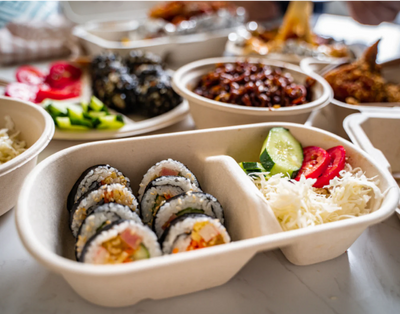

Your takeaway arrives piping hot.
You open the bag, lift the lid and dig in. By the time lunch is over, the container goes into the bin and you probably never think about it again.
But have you ever wondered what happens while hot food is sitting inside plastic packaging?
As conversations around microplastics in food continue to grow, researchers are paying closer attention to the many ways tiny plastic particles can enter our food and drinks.
Food packaging is one area being studied.
So, should you panic every time your lunch arrives in a plastic container?
No.
But it is worth understanding what scientists are discovering, where uncertainty remains, and why the materials touching our food deserve more attention.
First, What Are Microplastics?

Microplastics are very small pieces of plastic, generally defined as particles smaller than 5 millimetres.
Some are intentionally manufactured at a small size, while others form when larger plastic materials break down through processes such as heat, friction, weathering or general wear.
They have now been detected across many parts of our environment, including water, soil, air and food.
That means food packaging isn't the only potential source of exposure.
Microplastics can enter the food chain at multiple points, long before your takeaway order reaches the front door.
Can Plastic Food Containers Release Microplastics?

Research has shown that some plastic food-contact materials can release microplastic particles under certain conditions.
However, there isn't one universal answer for every plastic container.
The amount released can vary depending on factors such as:
-
The type of plastic
-
Temperature
-
Length of contact
-
Repeated use
-
Physical wear or damage
-
The type of food or liquid
-
How the container is heated or handled
This is an important distinction.
Seeing the words "plastic container" doesn't tell you exactly how that particular product will behave.
But research into food-contact materials does give consumers a good reason to pay attention to how packaging is used.
Why Does Heat Matter?
Temperature is one factor researchers examine when studying interactions between plastic and food.
Think about how takeaway packaging is actually used.
Soup might go into a container immediately after leaving the stove.
A freshly cooked curry could be packed while steaming.
Coffee is poured hot into a takeaway cup.
Leftovers may later be reheated in their original container.
These situations expose packaging to conditions very different from simply storing something at room temperature.
Research on certain plastic food-contact products has found that higher temperatures can influence the release of microplastics or other substances from some materials.
That doesn't mean every plastic container releases the same amount, or that eating one hot takeaway meal automatically creates a specific health outcome.
It does mean we should follow manufacturers' instructions about how packaging is intended to be used, particularly when reheating food.
What About Microwaving Plastic Containers?
We've all done it.
Yesterday's takeaway goes straight from the refrigerator into the microwave, often in exactly the same container it arrived in.
But not every takeaway container is designed for reheating.
If a container isn't clearly labelled as suitable for microwave use, transfer the food to microwave-safe glass or ceramic cookware before heating it.
Even when packaging is labelled for a particular use, follow the manufacturer's temperature and usage instructions.
This isn't just about microplastics. Food packaging is engineered for particular conditions, and using it outside those conditions may affect its performance.
Does This Mean Plastic Packaging Is Unsafe?
This is where discussions about microplastics can quickly become sensational.
Finding microplastics in a particular setting does not, by itself, establish what level of exposure causes a specific health effect in humans.
Scientists continue to investigate how people are exposed to microplastics, what happens after exposure, and what the potential long-term implications may be.
There are still important questions to answer.
So rather than making claims such as “plastic takeaway containers are toxic”, a more useful conclusion is:
We are learning more about how plastic interacts with our food and environment, and material choice deserves thoughtful attention.
Your Takeaway Container Has a Much Longer Story
There is another reason to think about food packaging.
Its life doesn't begin when your lunch arrives.
And it doesn't necessarily end when you throw it away.
A takeaway container goes through an entire lifecycle:
Raw materials are sourced.
The container is manufactured.
It is transported.
A restaurant uses it.
You eat from it, perhaps for 20 or 30 minutes.
Then it enters a waste system.
That final stage can last considerably longer than the meal itself.
This is why packaging conversations shouldn't focus only on what happens while you're eating.
We also need to consider what materials we're producing for such short periods of use and what happens to them afterwards.
What Are the Alternatives to Conventional Plastic Food Containers?

Food businesses today have access to a much wider range of packaging materials than they did in the past.
Depending on the application, alternatives can include paper, reusable packaging systems and containers made using plant fibres such as sugarcane.
Sugarcane fibre, often known as bagasse, is the fibrous material remaining after juice is extracted from sugarcane.
Instead of treating this material solely as agricultural residue, it can be processed into products such as:
-
Food containers
-
Plates
-
Bowls
-
Trays
-
Takeaway packaging
For restaurants and consumers looking to reduce reliance on conventional plastic food containers, fibre-based packaging provides another option worth considering.
Why Sugarcane Fibre Works Well for Takeaway Food

Takeaway packaging still needs to do its job.
A sustainable material isn't particularly useful to a restaurant if the container collapses before the meal reaches the customer.
Packaging needs to balance material considerations with real-world performance.
Sugarcane food containers can be designed to accommodate a variety of hot and cold foods while providing the structure needed for takeaway and delivery.
They're particularly useful for meals such as:
-
Rice dishes
-
Salads
-
Pasta
-
Noodles
-
Sandwiches
-
Baked goods
-
Prepared lunches
Their natural appearance can also complement restaurants looking for a cleaner, more considered takeaway presentation.
Not All “Plant-Based” Packaging Is the Same
This is where reading beyond the front of the package becomes important.
A container, cup or straw may be described using words such as:
plant-based
bio-based
compostable
made from sugarcane
Those terms can tell you something useful, but they don't necessarily tell you the complete material composition.
For example, some food-service products can incorporate PLA, a type of bioplastic commonly made from renewable resources.
PLA comes from a different feedstock than conventional fossil-based plastics, but it is still a polymer classified as plastic.
So if your goal is specifically to choose a product without PLA, don't assume that "plant-based" automatically means "PLA-free".
Look for clear material information and credible verification.
What About PFAS?
Material transparency isn't limited to plastic.
PFAS are a large group of synthetic chemicals that have historically been used in many applications because of properties such as resistance to grease, water and heat.
As awareness has grown, PFAS use in food packaging has received increasing scrutiny.
For buyers choosing fibre-based food packaging, this raises another useful question:
Has the product been verified as PFAS-free?
This is why certifications and testing matter.
Instead of relying only on broad terms such as "natural" or "eco-friendly", consumers and businesses can look for evidence supporting specific product claims.
What Should You Look for When Choosing Takeaway Packaging?
You don't need to become a materials scientist before ordering lunch.
But whether you're a consumer, restaurant owner or procurement manager, a few questions can help.
What is the product actually made from?
Look beyond the headline claim and check the material composition.
Is it appropriate for the food being served?
Packaging designed for cold food isn't automatically suitable for steaming-hot meals.
Can it be reheated?
Never assume. Check the manufacturer's instructions.
What environmental claims are being made?
Terms such as biodegradable and compostable are more useful when accompanied by specific conditions and recognised standards.
Are important claims independently verified?
Certification can provide more confidence than a sustainability slogan alone.
Where EQUO Fits In

EQUO develops food-service products using alternative materials with an emphasis on material transparency and verified claims.
For customers comparing takeaway packaging, features such as PLA-free and PFAS-free verification provide additional information about what is, and isn't, in the product.
That distinction matters.
Because two takeaway containers can look almost identical while having very different material compositions.
For EQUO, the goal isn't to make consumers afraid of their lunch containers.
It's to make it easier for people and businesses to understand what they're choosing.
Less Fear. More Transparency.
Microplastics are a complicated environmental and scientific issue.
Research is continuing, and there is still much to learn about the different sources of human exposure and their potential implications.
What we can do today is ask better questions.
What materials are touching our food?
Are we using packaging as intended?
Do we need disposable plastic for every application?
What alternatives are available?
And when a product makes an environmental claim, what evidence supports it?
Those questions lead to more informed choices without relying on fear or exaggerated promises.
The next time your takeaway arrives, you might look at the container a little differently.
After all, packaging may only hold your lunch for half an hour.
But the material we choose can have a story that lasts much longer.
Explore EQUO's sugarcane food containers and food-service solutions designed for businesses looking for practical alternatives to conventional plastic packaging.
SEO Keywords: microplastics in food, microplastics from plastic containers, plastic food containers, hot food in plastic containers, microplastics in takeaway food, takeaway food packaging, sugarcane food containers, plastic free food containers, PFAS free food packaging, PLA free packaging, sustainable takeaway containers, food packaging materials